Eat With Intention: Fueling Your Move Together Challenge
A Move Together Challenge asks more of your body than a typical training week. More volume, more intensity, more recovery — and that means nutrition matters more, too. The good news is that you don't have to overhaul how you eat. You just have to be a little more intentional about it.
Our nutrition team breaks down the fundamentals, including what your body needs during a challenge month, and the two nutrition approaches Move Together offers to help you get there.
Why Nutrition Matters More During a Challenge
During a challenge month, your training volume goes up. Your body needs fuel to perform, recover, and come back ready to do it again. When nutrition isn't keeping pace with training, you'll feel it — in your energy, your recovery, your mood, and eventually your results.
This isn't about eating perfectly. It's about eating with enough intention that your body has what it needs to do the work.
The three macronutrients — carbohydrates, protein, and fat — each play a role.
Carbohydrates are your body's primary fuel source during higher-intensity training. As Courtney Rushing, Moves’ Nutritionist with a Master's in Clinical Nutrition, puts it: "One of the biggest shifts is making sure carbohydrates aren't an afterthought around training. If you're under-fueled on carbs going into a session, you may not have the same output, and if you don't replenish afterward, recovery can suffer."
Protein is the building block of life. It's involved in nearly all bodily processes, including building and repairing muscles, cell growth, and renewal. It also supports muscle mass and helps prevent muscle wasting during periods of higher training volume. "Providing an adequate dose of high-quality protein at multiple meals gives us repeated opportunities to stimulate muscle protein synthesis — the process of building and repairing muscle," says Courtney.
Fat supports hormones, energy storage, and absorbing key vitamins A, D, E, and K. Focus on unsaturated fats — avocados, nuts, seeds, olive oil — as your primary sources.
When all three macronutrients are in balance, everything else tends to fall into place.
Two Approaches. One Goal.
Move Together offers two ways to approach nutrition during the challenge: Macro Counting and Build Your Plate. Neither is better than the other — it just depends on you.
Macro Counting
"Macro tracking is for the person who wants data — structure, numbers, and clarity. You have a specific goal in mind and you want to know exactly how much you're eating," says Courtney.
It teaches portion awareness and nutrient balance, and gives you a clear path to adjust when progress stalls. It does require effort and consistency, and a willingness to track and log your food. But for the right person, it's a clear and measurable path forward.
Move Together provides both maintenance and fat loss macro counts, because most of the year should be spent at maintenance, while fat loss phases are most effective when they're short and strategic. Specific guidance is provided for pregnancy and breastfeeding phases, too.
Build Your Plate
The Build Your Plate method is for the person who wants simplicity — no tracking, no apps. As Courtney puts it: "It's for someone looking for a more relaxed and intuitive way to meet their goals — someone who finds that weighing, measuring, and tracking food adds more stress than success." You're building habits instead:
The proportions shift slightly based on your life stage and goals (maintenance, fat loss, pregnancy, or endurance), but the framework stays the same.
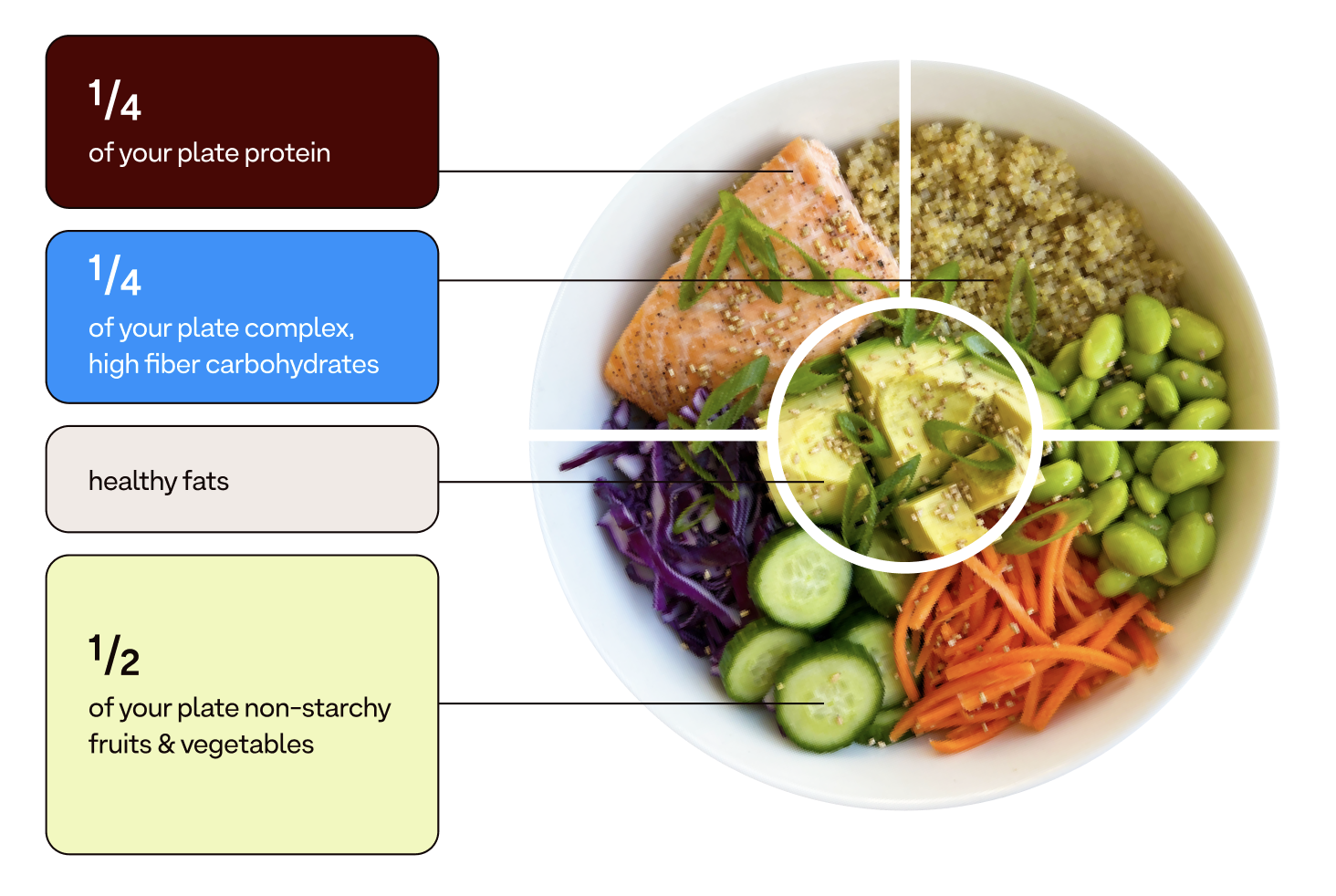
- A quarter: protein
- A quarter: complex, high-fiber carbohydrates
- Healthy fats to round it out
- Half your plate: non-starchy fruits and vegetables
How Do You Choose?
"If you feel stuck, inconsistent, or like you're doing everything right but not seeing results, you probably need more structure — and that's where tracking macros can really come in handy," says Courtney. "However, if you feel burnout or obsessed with numbers and just want a more sustainable lifestyle approach, building your plate might be the move."
Both can work. Both can get you results. It's not about which method is best, it's about which one you can stay consistent with.
The One Thing Both Approaches Have in Common
Whether you're counting macros or building your plate, quality matters. Prioritize complex carbs, fiber-rich foods, quality protein sources, and mostly whole foods. Enjoy the ice cream, then a green smoothie. It's not about restriction, it's about finding the middle ground. Eat food that you love, that helps you reach your goals, and that fuels and nourishes your body.
And during a challenge month especially: don't undereat. More training means more fuel. If you're noticing extreme hunger, fatigue, irritability, poor sleep, or digestive changes, those are signs your body needs more — not less.
As Courtney puts it: "When someone finally trusts the programming and starts adequately fueling, their body is often the first thing to tell us we're moving in the right direction."
Ready to train with purpose and fuel with intention?
Sign up for the Fall 2026 Move Together Challenge and get everything you need to make both happen.

.png)