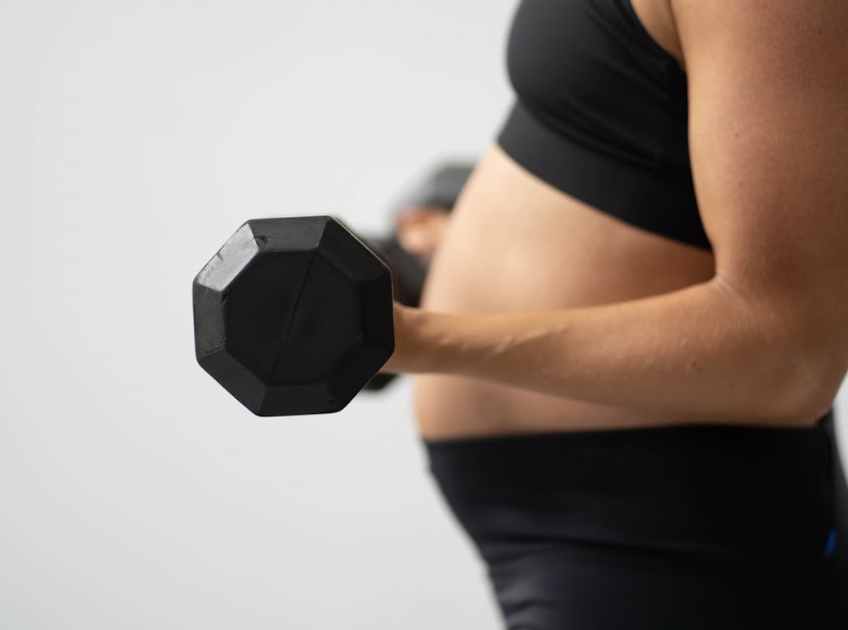
Most nutrition advice for women who lift starts and ends with protein. Courtney Rushing, a Nutritionist with a Master's in Clinical Nutrition, and Heather Pavlik, a Registered Dietitian, think there's more to the story.
Together, they make up the nutrition team behind Moves Plus, the membership that pairs expert-programmed workouts with RD-built meal planning. They sat down to share how they think about fueling women who lift, including what to eat, when to eat it, and why most of the advice doesn’t hold up in real life.
Why results stall, even when the effort is there…
Courtney: I look at two things first: food and performance. Saying you strength train is one thing, but actually implementing progressive overload is another. Are you challenging yourself? Are your weights, reps, or overall training capacity increasing over time? If not, simply showing up and lifting weights may not be enough to create the adaptation you're looking for.
Then we add fueling on top of that. So many women who strength train are still severely under-eating. That doesn't just limit muscle growth, it limits performance, recovery, and your ability to progressively overload in the first place. You can't expect your body to build and perform when you're consistently giving it less energy than it needs.
What "eat more protein" gets wrong...
Courtney: The biggest thing it gets wrong is that it puts protein on such a pedestal that women start ignoring everything else — especially carbohydrates.
Don't get me wrong, protein is incredibly important for building and maintaining muscle. But I've seen women become fixated on hitting unnecessarily high protein targets while barely eating enough carbohydrates to support the training they're doing.
If you're strength training, carbohydrates matter. They provide readily available fuel for higher-intensity exercise, help replenish muscle glycogen, and support your ability to train hard and recover so you can do it again. And ultimately, that's what drives adaptation. Eating another protein bar isn't going to make up for consistently showing up to your workouts under-fueled.
I think we've almost overcorrected. We spent years telling women to eat less, and now we're telling them to eat more protein, when the better message is eat enough food and fuel for what you're asking your body to do.
How to think about protein across a day...
Heather: Protein needs are incredibly important and often an afterthought. While total daily protein intake is the biggest priority, we also have data supporting distributing protein across the day rather than consuming the majority of it in one or two meals. Providing an adequate dose of high-quality protein at multiple meals gives us repeated opportunities to stimulate muscle protein synthesis — the process of building and repairing muscle. Practically, that often looks like aiming for roughly 25–40 grams of protein at each main meal, depending on your body size and overall protein needs.
The most common nutrition myth they see...
Courtney: Back to carbs again. One of the biggest is still that carbs are the enemy — especially if fat loss is also a goal. Women will slash carbohydrates because they think that's what they need to do to get lean. Meanwhile, they're trying to lift heavy four or five days a week and wondering why their performance, energy, and recovery aren't improving. Protein may get all the attention, but protein can't do the job alone.
What eating to support training actually looks like...
Heather: The biggest shift is making sure carbohydrates aren't an afterthought around training. Carbs are your body's main fuel source — they break down into glucose and can be stored as glycogen in your muscles and liver, giving your body readily available energy during training. If you're under-fueled on carbs going into a session, you may not have the same output, and if you don't replenish afterward, recovery can suffer.
So practically: Aim to have some carbohydrate and protein in the meal or snack before training, and prioritize refueling with both again afterward. It doesn't need to be complicated — this isn't about a narrow "anabolic window," it's about making sure your overall daily intake is enough to fuel and recover from what you're asking your body to do.
Moving away from a restriction mindset...
Courtney: I commonly use a reverse diet with clients who have spent years under-eating. There's nothing magical about reverse dieting — it's simply a structured way to gradually increase intake while allowing someone to pay attention to how their body responds.
The biofeedback piece is something I've preached about for years. Instead of judging progress solely by the scale, we start asking: How is your energy? How are you sleeping? How is your digestion? Are you recovering? Are your lifts improving? Are you less food-focused? How do you actually feel?
When someone finally trusts the programming and starts adequately fueling, their body is often the first thing to tell us we're moving in the right direction — but that progress doesn't always show up immediately in weight or measurements. It might first show up as better energy, better performance, improved sleep, better digestion, or feeling stronger in the gym. Once those pieces start functioning well, the physique changes tend to follow. And when a woman realizes how good she can feel, how much better she can perform, and how much happier she is when food isn't something she's constantly fighting against — everything changes.
What makes a week of meals repeatable and realistic...
Courtney: Balance and realism. If your nutrition plan only works when you have four hours to meal prep on Sunday and everyone in your family agrees to eat exactly what you're eating, it's probably not going to last.
I like meals that have a basic framework: a quality protein source, carbohydrates, produce, healthy fats, and plenty of fiber throughout the day. From there, make it work for your actual life. You don't need seven different breakfasts, lunches, and dinners every week. Repeat a few breakfasts and lunches you love, rotate dinners, utilize leftovers, and find meals that can easily be adjusted for different family members. Keep convenient foods around, too — convenience does not always mean unhealthy.
The problem Moves Plus was built to solve...
Heather: The biggest problem we were trying to solve was taking out the guesswork. People tell us all the time that they love not having to think about their workout — they just open the app, click the workout for that day, and go. We wanted that same philosophy for our weekly meal recommendations.
Within those recommendations, we tried to be intentional in a few ways. Two of the dinners share a similar protein, so you can batch-prep one protein or only need to buy one protein source for most of the week. Across the dinners and sometimes the lunch too, we look for overlapping ingredients — so if a recipe calls for a head of cabbage, we try to find another recipe that also uses cabbage, rather than someone using a quarter of it and letting the rest rot in the fridge.
The standard every Moves Plus recipe has to meet...
Heather: The weekly meal suggestions themselves aren't individualized or personalized to anyone's specific nutrition goals. But what actually does the work is the standard every recipe in our library has to meet before it goes into rotation. It's one thing to tell someone to eat enough protein, prioritize fiber, include carbohydrates to support training, and build balanced meals — it's another to give them simple, realistic meals that already do those things.
At a high level, every recipe has to be high protein, low to moderate fat, moderate carbohydrates, meets a minimum fiber threshold, and is made mostly from whole, real food ingredients.
What women actually need, and where Moves Plus fits in...
Courtney: One of the biggest things people need is a plan that meets them where they are. In almost 10 years of coaching, I've seen over and over again that people struggle when they're constantly winging it. They don't necessarily need more nutrition information — they need a framework that helps them put that information into practice.
That's where I think Moves Plus can be incredibly valuable. You have the training and the nutrition working together instead of treating them like two completely separate things. You have balanced, high-protein, fiber-rich recipes built around whole foods, alongside programming that gives your workouts structure and progression. You don't have to wake up every day wondering, What should I eat? What workout should I do? Am I doing enough? The plan is there. Your job is to follow it consistently enough to let it work.
Ready to stop guessing what to eat?
Moves Plus takes care of your meals the same way Moves takes care of your workouts — so all you have to do is show up.
Explore Moves Plus Meal Planning