MOVES PROGRAMMING PHILOSOPHY
Workouts you trust. Strength you feel.
Experience structured, science-backed training you’ll enjoy — designed to eliminate the guesswork and decision fatigue.
Let’s break it down. Whether you’re new and wondering what sets Moves apart, or you’ve been loving the workouts but can’t quite put your finger on why they feel so impactful, here’s the philosophy behind it all:
What does a “Strength-First Approach” mean?
Our strength-first approach ignites the engine behind both looking good and moving well, without wasting time. Cardio is great. Mobility matters. They both have a place. But strength is the thing that actually changes your body and what it’s capable of.
Why are my results with Moves better and faster than other approaches?
Your results are expedited because you’re working on both body composition (higher muscle mass and less fat) and functional fitness at the same time. Our programming is backed by Physical Therapists to ensure your body is prepared to meet life’s demands as you age. By training dynamically, you stabilize joints, reduce injury risk, improve posture, support bone density, and preserve athleticism.
We understand the very real balance of wanting to feel confident in your skin while also feeling capable in your fitness. Moves delivers both in every workout.
What is the deep core link?
Moves is designed by experts for women, and the connection between the deep core and pelvic floor is essential to both life and fitness, yet often overlooked. Moves provides a tailored, specific approach for different phases of life, whether that’s pregnancy, postpartum, years after rehab, or beyond. From there, we continue progressing your strength through more advanced movements woven directly into your program.
When you’re supported through breath, form, and function and we address the system as a whole instead of spot-treating symptoms, real progress begins.
How Moves App simplifies “Progressive Overload”:
When it comes to building strength, muscle, and overall fitness, progressive overload is often highlighted as the cornerstone principle. But understanding its definition and intention is key, especially when longevity, functionality, and well-roundedness are valued just as much as aesthetics.
You’ve probably heard the more dogmatic approach to training: “Progressive overload and repeating workouts week after week is the only way to build muscle. You must gradually increase resistance or intensity to challenge your muscles and stimulate growth.” And yes, that principle works.
A common pitfall, however, is thinking of progressive overload as exclusively endless repetition.
At Moves, we believe in progressive overload and progressive stimulus. You’ll absolutely gain strength and muscle by gradually increasing resistance over time, but you’ll also reap additional benefits by varying movement patterns, tempos, planes of motion, and demands on the body.
That broader approach is what supports not just muscle growth, but resilience, longevity, and real-world functionality.
What is Progressive Overload?
Progressive overload is commonly defined as the gradual increase in stress placed on your musculoskeletal system through exercise. This can be achieved by:
- Increasing the weight you lift
- Adding more repetitions or sets
- Decreasing rest time between sets
- Increasing overall training volume or intensity
The concept is straightforward: consistently challenging your muscles forces them to adapt, leading to strength gains and hypertrophy, or muscle growth. It’s a proven method, especially when applied systematically over time and when progress is clearly tracked.
Trainer Tip:
Madeline here – this is the lightbulb for me that has helped me enjoy training without ignoring the facts of exercise physiology. I’m not here to waste time, but I’m also not here to slog through every workout doing the exact same versions of lunges and squats for months on end.
It’s this simple: if I repeatedly create mechanical tension, I’m mastering progressive overload without being a slave to numbers. Here’s what I mean – your body and muscles will get stronger over time if you are creating hard sets and getting close to failure (within 1-3 reps is where I like to hang out). When that keeps happening over time and you get stronger, it will take MORE to create mechanical tension and create hard sets which is the definition of progressive overload!
I find so much freedom in realizing that I am not a robot and that if I am pushing myself to find those gritty corners of my sets by choosing challenging weights, sticking to proper form, optimizing tempo and mind to muscle connection and am going to create adaptations and by continuing to do it, progressive overload is a natural byproduct.
What does this do well?
It provides an evidenced-based framework for improvements to strength, endurance, and hypertrophy in an easy to track format.
Where does this fall short?
It can often neglect other aspects of human movement and function including mobility, coordination and balance. It also can undervalue the importance of the cognitive and emotional link in training, skill development and having a general enjoyment of training.
How does Moves ensure the benefits?
Moves incorporates progressive overload through the repetition of foundational movement patterns (hinge, squat, push, pull, carry, and lunge) each week throughout the month in Challenge Moves. These movements are intentionally selected because of their strong carryover to real life and total-body strength.
Consistent exposure to these patterns allows you to refine form, track reps, and progressively increase load without sacrificing technique in the pursuit of progress.
At the same time, while there is clear opportunity to implement progressive overload, there is also intentional variety in the accessory portions of each workout. This helps reduce the risk of overuse injuries, strengthen supporting muscles, improve posture, develop power, enhance balance, and maintain personal enjoyment.
This is where progressive stimulus comes in.
Moves App: Where Progressive Overload and Stimulus Meet
While progressive overload is a key component of building strength, it’s only one piece of the puzzle. The broader concept of progressive stimulus emphasizes exposing your body to a variety of intentional challenges over time, enhancing not just strength, but power, athleticism, hypertrophy, conditioning, mobility, and more.
This is where Moves workouts stand apart and where many people’s understanding of training often falls short. Variety alone isn’t the goal. Variety with intention is.
Our approach is rooted not only in exercise science, but also in real-world feedback from working with hundreds of thousands of busy, results-driven women across every age and stage of life.
Here’s what that looks like in practice:
- Variation prevents plateaus. Repeating the exact same exercises indefinitely can lead to stagnation, reduced enjoyment, muscular imbalances, and unnecessary wear and tear. Your body adapts. Progress slows unless new stimulus is introduced.
- Skill development. Rotating movements improves neuromuscular coordination, balance, and stability, all of which are essential for functional strength and injury prevention.
- Mobility and flexibility. Diverse movement patterns and ranges of motion help maintain and improve joint health over time.
- Holistic fitness. Training across multiple stimuli builds overall resilience, not just strength in isolated muscles.
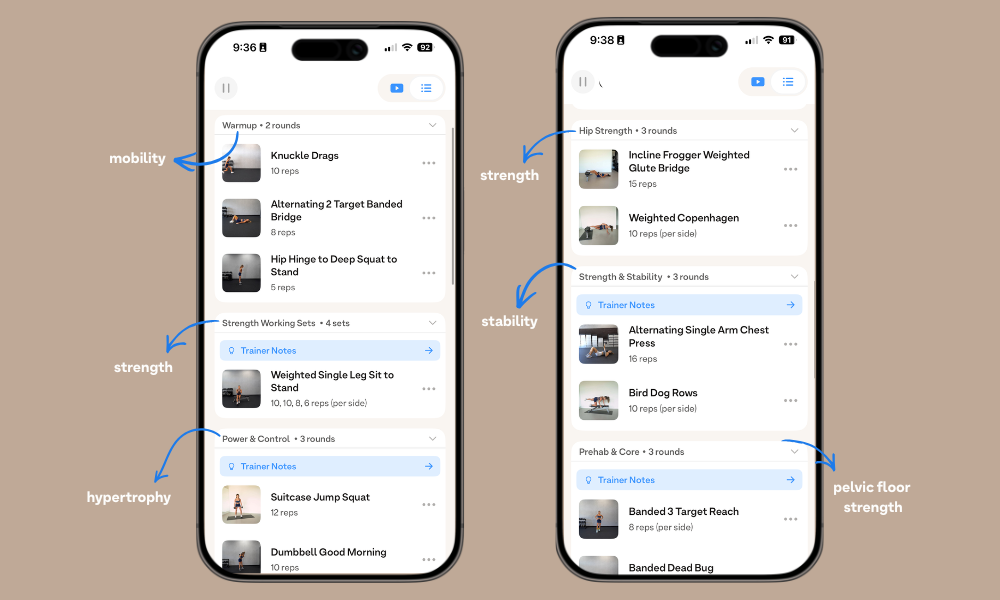
Where Foundational Movements and Variety Meet with Intention, Producing Better Results
- Building strength and muscle.
The foundation of every workout is built on the staples for a reason. Squat, hinge, lunge, push, pull, and carry move us toward functional strength goals and must be repeated to get stronger. But here’s the nuance: there are hundreds of variations of each pattern. You don’t need to repeat the exact same variation week after week to see progress. Repeating the movement pattern builds strength, while different variations provide unique benefits and carryover. - Promoting consistency.
Variety is the spice of life. While applying progressive overload to the same variation week after week will absolutely make you stronger, most people are far more consistent when there’s thoughtful variation built in. Consistency drives results, and enjoyment fuels consistency. - Enhancing motor skills.
Learning new exercises promotes neural adaptation and coordination, improving overall movement quality. Over time, you also improve your ability to learn new skills and perform unfamiliar tasks effectively and safely. - Reducing injury risk.
A balanced approach that incorporates multiple movement planes and loading strategies develops well-rounded strength and stability. Core training and full-body stability work may not allow you to lift the heaviest loads, but they are essential for protecting joints and supporting long-term progress. - Improving mobility.
Dynamic stretching, controlled articular rotations, and varied movement angles support joint health and help you move confidently through both life’s expected and unexpected twists and turns.
How Weekly Moves Builds from Foundation Moves
Three workouts per week begin with a prime example of progressive stimulus: our monthly Challenge Moves. These movements are repeated each week throughout the month, giving you ample opportunity to add weight or reps, refine form, and increase range of motion.
On many days, we follow with dedicated strength working sets. The focus here is lifting heavier loads, which is why you’ll notice lower rep counts. These are typically structured as a single exercise or superset so you can truly prioritize strength, rather than moving quickly through a multi-exercise circuit.
From there, you’ll see a variety of training structures, including isolation work, compound lifts, and finishers. Each week of Weekly Moves is intentionally programmed to provide adequate stimulus for all major muscle groups, ensuring steady forward progress.
We also emphasize muscle groups we know are a high priority for our community, like core, while thoughtfully balancing repetition and variety to keep you mentally engaged and physically challenged.
When foundational movements and intentional variety work together, you don’t just work out. You build strength that carries into real life.
That’s the philosophy behind every workout inside Moves. If you’re ready to train with more clarity, structure, and purpose, open the app and experience it for yourself..