


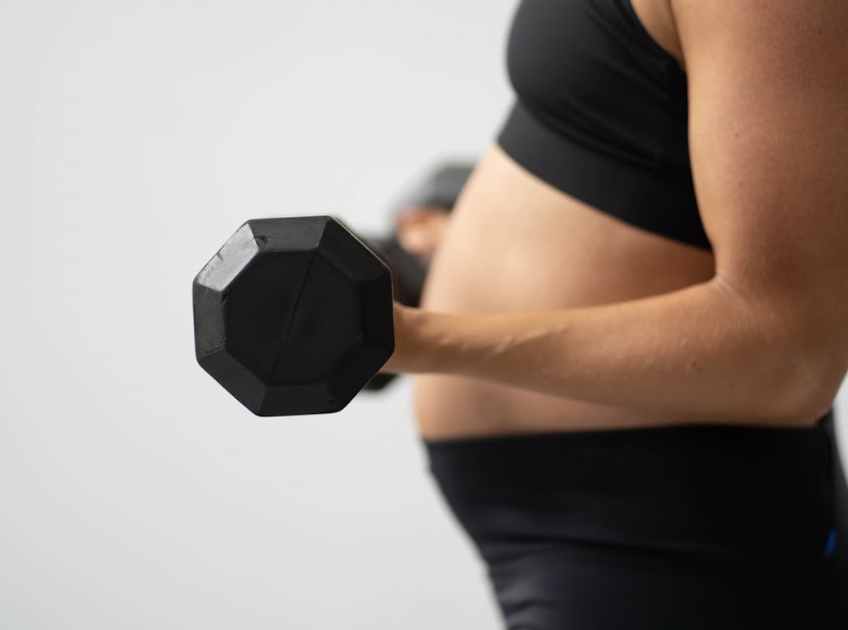
Is the Move Together Challenge Recommended for Pregnancy?
The Short Answer:
Yes, if your pregnancy is uncomplicated and your healthcare team hasn't given you any contraindications to exercise. We do recommend it most for women who already have some workout experience and feel confident recognizing when a movement needs to change – but you won't be left guessing what’s safe for you and your baby. While the Move Together Challenge isn't pregnancy-specific, every exercise that may need modifying has a prenatal-labeled alternate built right into the programming, created by Doctors of Physical Therapy and experts in women’s health and pelvic floor.
Research increasingly supports strength training during pregnancy. The right program for you is the one you enjoy and feel confident doing, and that can change from one trimester to the next. (For more on how training shifts trimester to trimester, here's our full guide to exercising during pregnancy.)
Disclaimer: Before starting a training program, seek approval from your medical provider and follow any recommendations regarding contraindications specifically identified by your provider.
How the Pregnancy Swaps Work
You'll see prenatal-labeled modifications throughout the app for core work, strength training, impact and cardio, lower-body movements, and exercise positions. You choose when to use them, and that's intentional. Being pregnant, or reaching a certain week, doesn't automatically mean an exercise needs to change.
"Pregnancy modifications are not one-size-fits-all, and you don't necessarily need to modify an exercise simply because you're pregnant or you've reached a certain week of pregnancy. Your training history, your stage of pregnancy, your symptoms, and honestly, what you feel comfortable and confident doing all matter."
— Dr. Katie Fincher, PT, DPT, CSCS, board-certified clinical specialist in pelvic and women's health physical therapy
Instead of a list of rules, the swaps give you options to use as your body changes.
"They're there as options — not because every pregnant woman needs every modification, but because your needs can change throughout pregnancy and even from one training day to the next," says Dr. Fincher. "Use the modifications when you need them, keep the original movement when it still feels good, and continue adapting as your body and pregnancy change."
So how do you know when to swap? Your symptoms tell you.
Six Signs It May Be Time to Swap
A symptom mid-workout usually isn't a reason to stop training. It's information you can act on, often with a small change to your breath, load, range of motion, stance, position, impact, or volume.
"Those symptoms don't automatically mean, 'I can't do this exercise anymore.' Think of them as information that may tell you it's time to adjust something."
— Dr. Katie Fincher, PT, DPT, CSCS
1. Coning or doming during core work
What you might notice: A visible ridge or dome down the midline of your abdomen during sit-ups, crunches, or other core exercises. This can signal increased intra-abdominal pressure.
What to try: Use band assistance on sit-ups, shorten the range of motion, or adjust your breathing. You can also swap to dead bugs, bird dogs, or Pallof presses.
"It does not mean that you need to stop training your core entirely," says Dr. Fincher.
2. Leaking with impact
What you might notice: Leaking urine during jump rope, box jumps, running, or other impact work.
What to try: Exhale through the hardest part of the effort, reduce impact or total volume, then build back up based on how your symptoms respond.
"It can be a sign that your pelvic floor and pressure-management system are having difficulty meeting the demands of that activity on that particular day," says Dr. Fincher. "It is not a reflection of your overall fitness level."
3. Pelvic heaviness, pressure, or bulging
What you might notice: Heaviness, pressure, or a bulging sensation during loaded lifts like a deadlift or overhead press. This can be related to breath holding or how pressure is managed under load.
What to try: Exhale through the more challenging portion of the movement, and adjust load, reps, or volume.
"Rather than abandoning strength training, try adjusting your breath strategy," says Dr. Fincher.
4. Pubic or groin pain
What you might notice: Pain at the front of the pelvis or groin. It can show up in wide-stance moves like sumo squats and lateral lunges, and also in single-leg or split-stance moves like lunges, step-ups, and running.
What to try: Narrow your stance, shorten your range of motion, lower the load, or choose a more symmetrical variation.
"The goal is to modify the movement that is provoking symptoms rather than automatically stopping lower-body training altogether," says Dr. Fincher.
5. Dizziness when lying on your back
What you might notice: Dizziness or lightheadedness during supine exercises, especially later in pregnancy. The growing uterus can press on major blood vessels when you lie flat.
What to try: Move to an incline, seated, or side-lying version of the same exercise. If your symptoms don't clear once you've changed position, stop the movement.
"This does not mean that every pregnant woman has to completely stop exercising in a supine position after a specific week of pregnancy," says Dr. Fincher. "Instead, if you become symptomatic, transition to an incline, seated, or side-lying variation and see if your symptoms resolve."
6. Sharp or pulling pain with running or direction changes
What you might notice: Sharp or pulling discomfort in the lower abdomen or groin during running, agility work, or quick changes of direction. The tissues supporting the uterus are under more tension as pregnancy progresses.
What to try: Slow down direction changes, accelerate and decelerate more gradually, and reduce impact as needed. Progress based on comfort and symptom response.
"Pregnancy does not automatically mean you need to stop doing the exercises you enjoy," says Dr. Fincher. "The best modification is the one that allows you to continue moving while feeling strong, supported, and comfortable."
Want to go deeper on the pelvic floor side? Read What Your Pelvic Floor Is Trying to Tell You During Pregnancy.
When Modifying Isn't Enough
Some signs mean stop the workout and call your doctor, with no modification to try first:
- Difficulty breathing
- Chest pain
- Feeling dizzy or faint
- Disturbances of eyesight
- Heart palpitations
- Vaginal bleeding
- Regular, painful contractions
- Fluid gushing or leaking from the vagina
- Calf pain or swelling
- Headache with dizziness or heart palpitations
If one of the six swap signs doesn't improve after you've adjusted breath, load, position, or range, or it's getting worse, see a pelvic floor or women's health physical therapist. That isn't a sign you did something wrong. It's the next step toward guidance built for your body.
A Note from From Madeline, and How She is Approaching Move Together in Her Fourth Pregnancy
This is my 3rd challenge while pregnant AND the one I’m most excited for, so let me tell you why and a little bit about how I approach a “fitness challenge” in a way that supports my highest goal of growing life while prioritizing my health and baby’s!
I’m MOST excited about doing this challenge during my fourth pregnancy because this is the FIRST MOVE TOGETHER that is specifically prenatal-informed with expert content and explicit “pregnancy” swaps throughout the programming! It’s not an afterthought or something you’re left to figure out on your own. That said– the way you utilize the swaps is highly INDIVIDUAL and should be! Something that might feel good for one person in their second trimester may feel a little less comfortable for someone in their late third trimester and that’s normal! The goal is to provide effective, empowering programming that also supports your changing body.
My personal approach is to lean into these aspects of the challenge:
MINDSET
What I’m doing now is an investment in how I want to feel postpartum– capable and resilient. I know that by staying connected to my core, strength training, implementing mobility and cardio consistently, that will happen. It doesn’t have to be a challenge full of PR’s for me, but the excitement and novelty of these new workouts keeps me excited and I crave that when so much feels foreign in pregnancy. Also thrilled for the low impact day mid-week to reset, work on core correctives and mobility to ensure recovery is balanced, no burnout needed.
NUTRITION
The recipes provided support baby and mom with adequate macronutrients AND micronutrients, but are simple enough to feed my family and throw together on days the fatigue is setting in. They’re also straight delicious! I’m so here for the high protein Banana Puddling! You’re also provided a professional macro count and I know how confusing it can be to find trusted guidance on what or how much to eat during this time– handled!
COMMUNITY MOTIVATION
There are so many days I would just rather not and having the community’s energy helps boost my own and allows me to maintain more fitness and stay more active than I would without it. Pregnancy can feel LONG to me and I LOVE this pep in between that keeps me externally motivated and connected to such kind and supportive women.
Move Together or Mom Moves Prenatal?
Both are built with expert input. The difference is how much you want to decide for yourself.
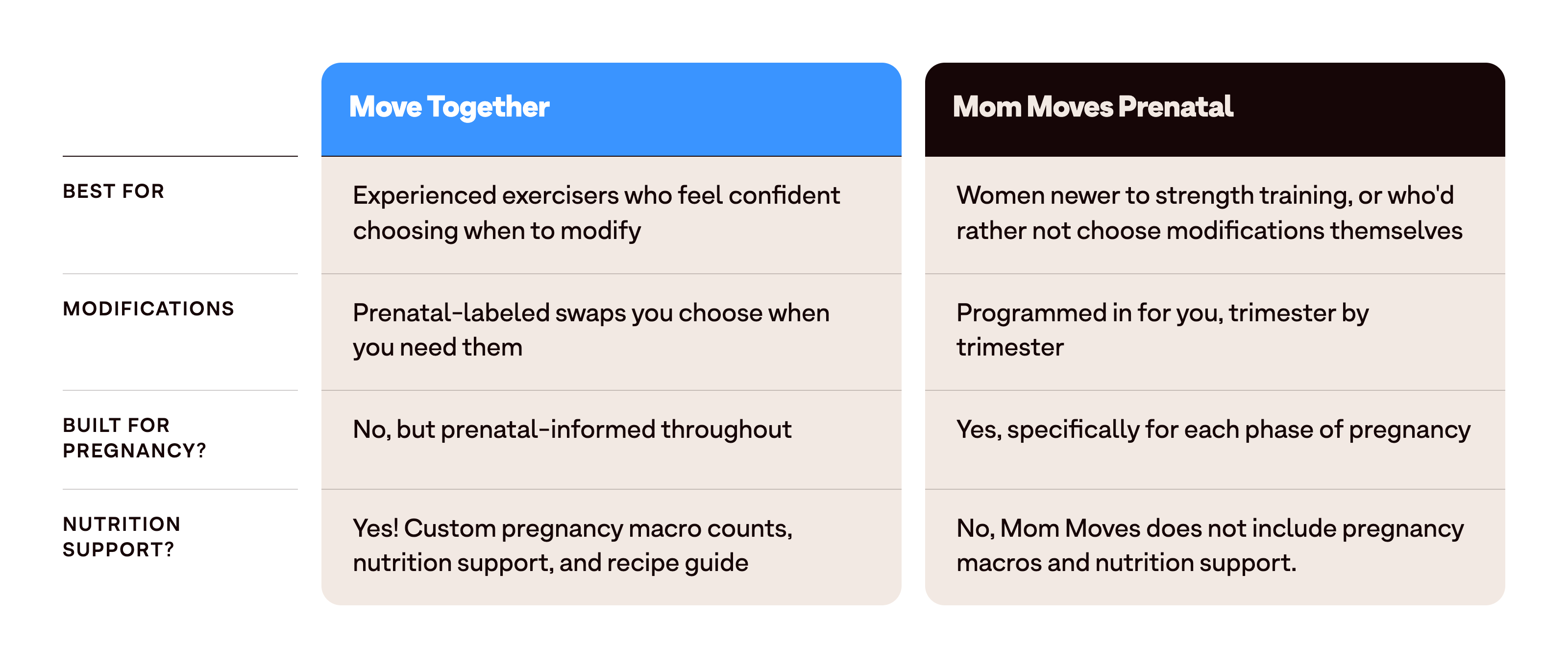
No matter which program you choose, talk to your doctor before starting, listen to your body, and consider working with a pelvic floor or women's health physical therapist for personalized guidance.
Ready to move together? Join the challenge in the Moves app, or start Mom Moves Prenatal if you'd like the modifications done for you.

.png)